System Context Is the Next Product Advantage
Every meaningful product advantage eventually expires.
I have spent much of my career working around that reality. A company finds leverage in a new channel, a better operating model, a technical edge, or a system competitors have not adopted yet. For a while, that advantage compounds. Then the market adapts, the tools become more accessible, and what once created separation becomes expected.
AI is moving through that same cycle quickly. The first obvious advantage is speed. Teams can write code faster, generate prototypes faster, summarize requirements faster, and move through implementation work with less friction. That is useful, but I do not think speed alone will stay differentiated for very long.
I initially assumed AI would push me toward another new product idea. Another side project. Another build around a major technology shift. But the more I worked with AI coding agents inside my existing systems, the more I realized the bigger opportunity was not building something new. It was making the systems I already had more understandable to AI.
That changed the question I was asking.
Instead of asking, “How can AI help me build more?” I started asking, “How should these systems be designed so AI can actually understand what it is changing?”
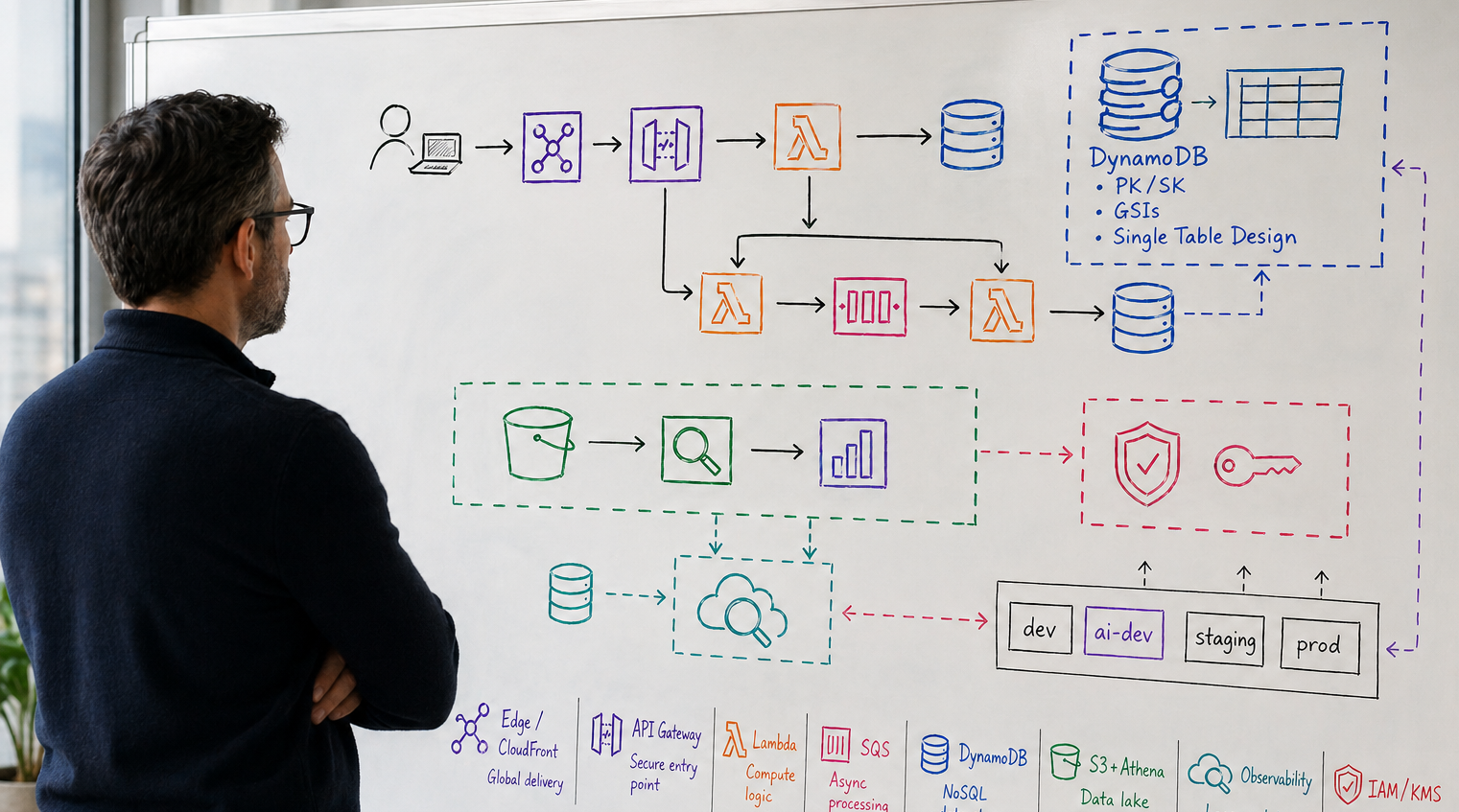
That distinction became especially clear working with SST and DynamoDB. They are powerful tools, but they also make system context incredibly important. In environments like that, the real complexity is not just the application code. It is the infrastructure design, deployment stages, entity models, PK/SK patterns, GSIs, queue states, logs, synthetic data, and operational boundaries that determine how the product actually behaves.
An AI agent can generate code against that system. But generating code is not the same as understanding the system. It may not know whether a schema change creates future scaling risk. It may not understand tenant partitioning. It may not see the queue state behind a failed workflow. It may not know which environment is safe to inspect and which one should remain untouched.
That was the gap.
The next layer of value was not more code generation. It was system comprehension.
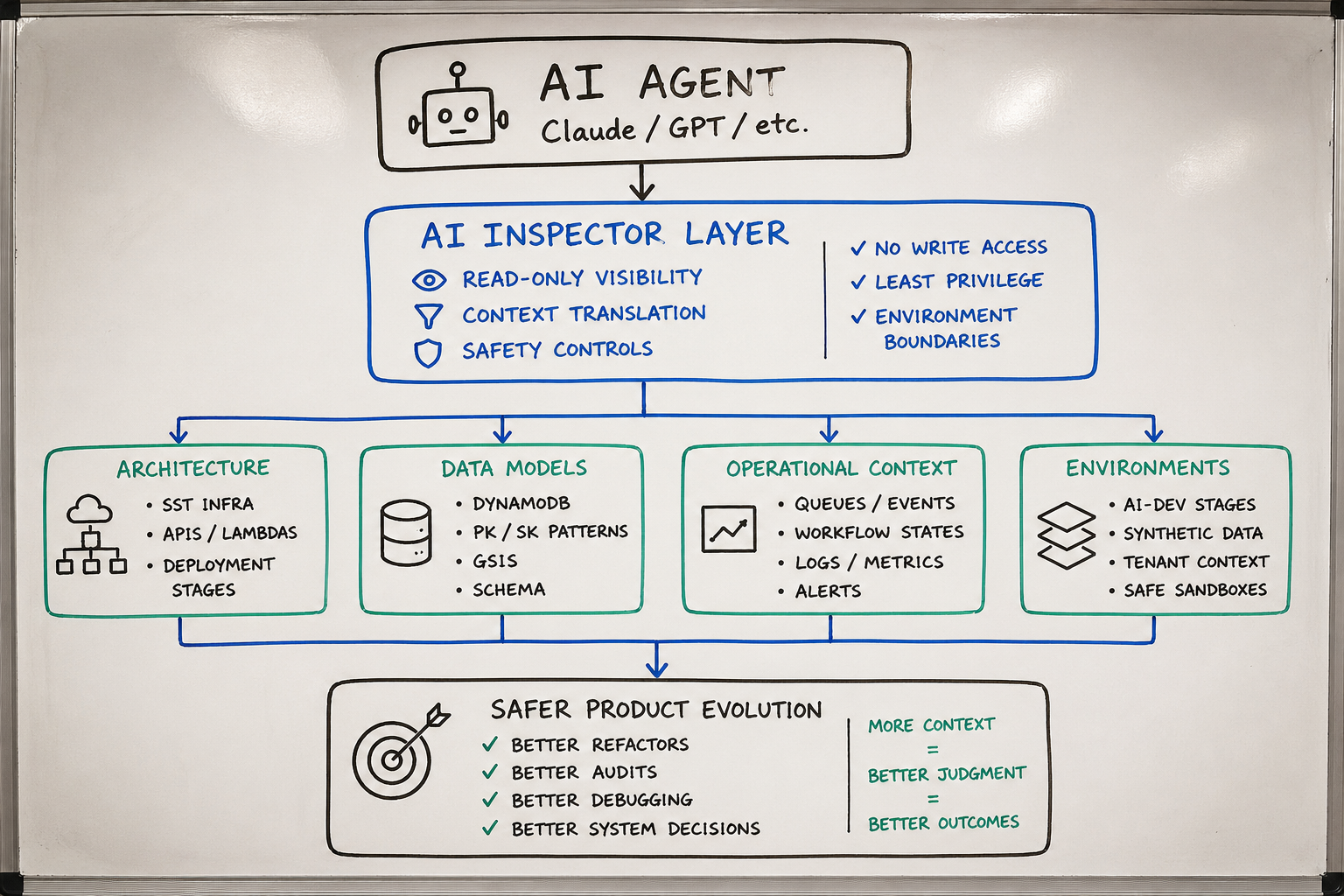
That led me toward what I now think of as Architecture-Aware AI. The idea is not to give AI unrestricted access or raw production credentials. It is to create a controlled layer where AI can safely inspect the system it is helping modify.
In practice, that might mean read-only Inspector APIs, AI-dev stages, synthetic tenant data, architecture maps, operational diagnostics, and controlled observability. The goal is not to make AI more powerful in a reckless way. The goal is to make it more informed, so its recommendations and changes are grounded in how the system actually works.
That is where the product advantage starts to become more interesting.
When AI has real system context, it can help with more than output. It can reason about refactors with more accuracy. It can debug with better judgment. It can audit architecture decisions. It can connect product changes to infrastructure consequences. It can help a team see operational risk earlier, before it turns into customer impact or technical debt.
That is a very different level of usefulness than asking AI to generate another function or scaffold another endpoint.
I think many organizations are still underestimating this shift. Most teams are focused on inserting AI into existing workflows. Fewer are asking whether their systems are designed in a way that AI can safely understand them. That may become a meaningful divide, especially in SaaS environments where complexity compounds over time.
Multi-tenant platforms, identity systems, event pipelines, queues, governance layers, and deployment environments all create hidden context. If AI cannot inspect that context safely, it will remain useful but limited. If it can understand that context, it starts becoming part of the operating model.
That is why Architecture-Aware AI feels important to me. Not because every company needs another AI product, and not because AI should be allowed to roam freely through production systems. The opportunity is more practical than that. Existing products can become dramatically easier to evolve when they are designed for safe AI comprehension.
This is also why the idea feels bigger than engineering productivity. For product and technology leaders, the real opportunity is not just faster execution. It is better system design, better operational visibility, and better decision-making inside the platforms already running the business.
I am not interested in AI because it can help build more things.
I am interested in how AI can help build better systems.
Because every advantage eventually becomes baseline. The next one may belong to teams that stop treating AI like a faster production tool and start designing systems it can actually understand.
AI becomes far more valuable when it understands what it is changing.